Zimbabwe's .ac.zw Domain System: When the Registrar Becomes the Bottleneck to Digitalisation
A firsthand account of establishing Magura High School's website, and the need for clearer requirements in Zimbabwe's academic domain-registration and management process.
In this article
- The school already has the infrastructure
- The first bottleneck: Requirements disclosed only after enquiry
- The second bottleneck: Another undisclosed requirement
- Where does the responsibility begin?
- Security is necessary, but so is proportionality
- This is not merely a rural problem
- Thousands of schools, but where are their websites?
- When the website is easier to build than the domain is to configure
- What should change?
- Digital transformation cannot succeed through guesswork
An attempt to establish a website for a Zimbabwean school exposes a troubling disconnect between modern digital infrastructure and the administrative processes governing our national domains. The problem is not simply bureaucracy but the failure to communicate it until customers encounter obstacles.
On 18 August 2026, I purchased the domain magurahighschool.ac.zw through name.co.zw, intending to establish an official website for Magura High School in Zaka District, Masvingo Province.
As a former student, my motivation was straightforward. I wanted to give back to the institution that contributed to my education by helping it establish a sustainable digital presence, something that I wished I had when I was at that stage.
The website would provide an official platform for communication, announcements, school activities, achievements and information relevant to parents, students, former students and the wider community.
The headmaster had already welcomed the initiative. This was not an attempt to register an institution's identity without its knowledge or consent.
I also committed to sponsoring the domain for the first ten years, giving the school a long-term foundation on which to develop its digital infrastructure.
What I did not anticipate was that purchasing and configuring a domain would prove more administratively complicated than building the website itself.
The school already has the infrastructure
It is worth establishing something important from the outset.
Magura High School is not waiting for someone to introduce it to the internet.
I previously donated Starlink equipment to the school in June 2025, helping provide the satellite connectivity needed for its digital activities.
That connectivity is particularly important to this project because the intention has never been to build a website that remains permanently dependent on someone outside the institution.
The long-term objective is to equip the school to maintain its own digital presence, publish updates, manage information and gradually assume responsibility for the platform.
The website is being developed using modern technologies, with GitHub providing version-controlled collaboration and Cloudflare Pages offering a low-maintenance hosting environment.
With its existing internet connectivity, appropriate training and delegated administrative access, the school has the foundation required to manage its website on a daily basis.
This matters because discussions about digitalisation in Zimbabwe often focus on the lack of infrastructure.
In this case, much of the necessary infrastructure already exists.
The institution has connectivity, the project has funding, the leadership has given its support, and the technical implementation is achievable.
Yet administrative obstacles have introduced delays at a stage where the project should be progressing towards deployment.
The first bottleneck: Requirements disclosed only after enquiry
When I purchased the domain through name.co.zw, I expected that any special registration requirements would be clearly communicated as part of the transaction. They weren't. After 2 weeks on pending, I started doing my own research that sent me to ZASPA website and ultimately their director's WhatsApp where I learned about writing to UZ Computer Centre, I did. Got no response. I wrote to name.co.zw and then they told me to ask the headmaster to write to UZ or to them.
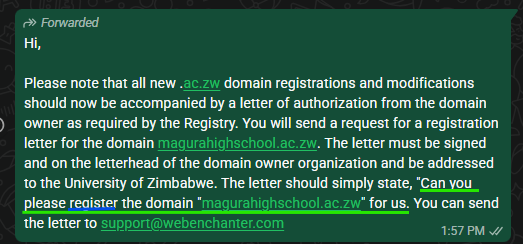
After all, .ac.zw is not an ordinary commercial extension.
It is intended for academic institutions, and verifying the legitimacy of an applicant is entirely reasonable.
However, I discovered the institutional authorisation requirements only after making enquiries.
The process involved obtaining documentation from the school, including a letter from the headmaster, to satisfy the verification requirements associated with the academic namespace.
I had no objection to providing that documentation.
My concern was why the process had not been clearly explained before or during the purchase.
By 2 September, more than two weeks after the domain purchase, registration was still pending.
The problem was not simply the time taken.
It was the uncertainty surrounding what needed to happen, who was responsible for the next stage and how long completion might reasonably take.
A customer should not have to investigate the registration requirements of a product after paying for it.
If a domain requires institutional verification, the registrar should explain that requirement before accepting payment, not leave customers to discover it through follow-up enquiries.
The second bottleneck: Another undisclosed requirement
After progressing through registration, I began configuring the school's website infrastructure.
The domain was initially delegated to ImpressiveHost nameservers. I wanted to move DNS management to Cloudflare, where the website's infrastructure would be maintained.
This was a technical configuration change, not an attempt to transfer ownership or change the institution associated with the domain.
I submitted the two Cloudflare nameservers through the management interface provided by name.co.zw.
The process appeared straightforward.
However, subsequent DNS checks against Google's and Cloudflare's public resolvers continued to return the original ImpressiveHost nameservers.
As someone always doing websites, I knew that standard DNS cache propagation can take time, I contacted the registrar, name.co.zw, to ask how long registry zone file updates generally take for .ac.zw domains.
I was informed that there was no estimated processing time for the registry to reload the zone, and that it might take several hours or days.
That was understandable, even if somewhat inconvenient.
Then came another message.
The registrar advised that all new .ac.zw domain registrations and modifications must now be accompanied by a signed authorisation letter from the domain owner, on official institutional letterhead, addressed to the University of Zimbabwe.
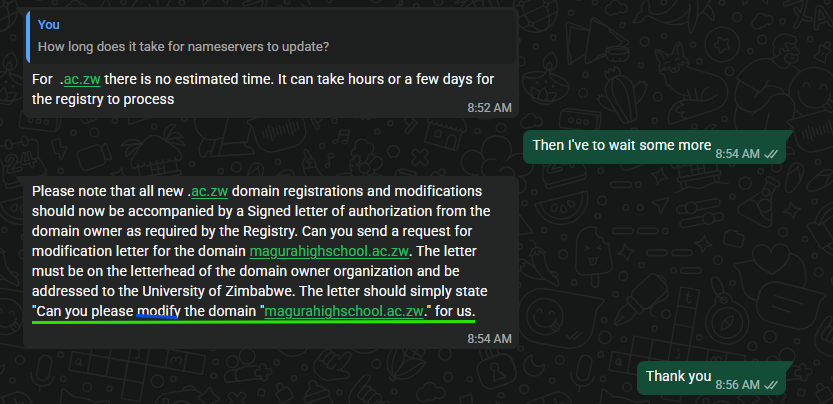
Once again, a material requirement had surfaced only after I asked about the delay.
This was the second time during the same project that I had encountered an important administrative condition that had not been proactively communicated to me.
Why had the registrar's nameserver modification interface not warned me that another letter might be required?
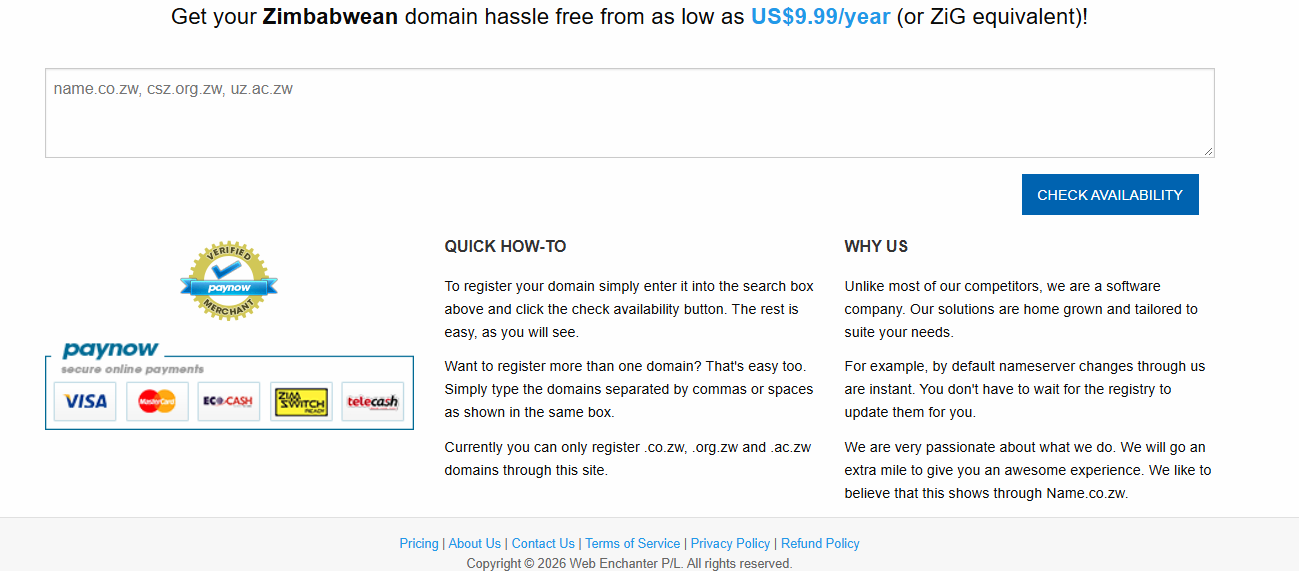
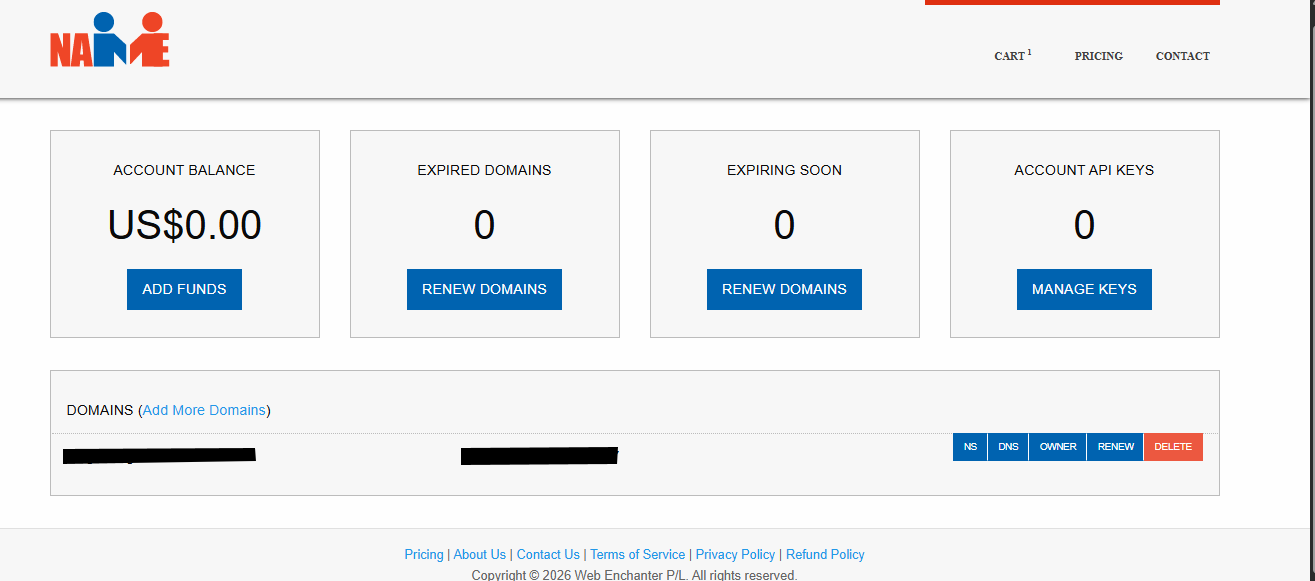
Why was the necessary documentation not requested when I initiated the change?
And why was I learning about the requirement through a WhatsApp enquiry rather than through the domain management system itself?
Where does the responsibility begin?
Zimbabwe's national domain infrastructure involves different parties.
POTRAZ oversees the .zw country-code domain, while the University of Zimbabwe has traditionally administered the .ac.zw academic namespace.
Commercial registrars such as name.co.zw provide the customer-facing services through which individuals and institutions register and manage domain names.
I appreciate that the registrar may not determine the policies imposed by the registry.
But that does not absolve it of responsibility for communicating those policies to its customers.
The registrar is the customer's point of entry into the system. It should also be the customer's primary source of accurate information about how that system works.
If institutional documentation is mandatory, that requirement should be visible at registration.
If nameserver modifications require additional authorisation, the management interface should disclose that requirement before the request is submitted.
If registry-level processing takes several days, the customer should receive an appropriate notice and a means of tracking progress.
A registrar cannot reasonably expect customers to understand unpublished or poorly communicated administrative procedures.
Nor should customers have to discover each new requirement by repeatedly contacting support.
I cannot establish from my experience alone which organisation was responsible for every delay.
What I can establish is that, on two separate occasions, I learned about material procedural requirements only after making enquiries with name.co.zw.
That is a customer-service and process-design failure worth examining independently of the registry's underlying policies.
Security is necessary, but so is proportionality
There are legitimate reasons to protect academic domain registrations.
An institution's official domain represents its identity, reputation and communication channels.
A malicious or unauthorised nameserver change could redirect its website, interfere with email delivery or expose users to fraudulent services.
Changing authoritative DNS is therefore a security-sensitive action, even though it does not transfer legal ownership of the domain.
I do not dispute the need for authorisation.
What I question is the apparent dependence on repeated letters when a verified institution should be able to designate authorised technical administrators.
Why should a school headmaster need to issue fresh correspondence for a routine configuration change after the institution has already established its identity and approved the project?
A more modern system could provide secure institutional accounts, delegated technical roles, multifactor authentication and digital approval workflows.
Sensitive changes could still require confirmation from the institution's designated authority.
But that confirmation need not depend on an unpredictable exchange of manually processed paperwork.
Protecting institutional identity and enabling efficient administration are not competing objectives.
Both are achievable with appropriate system design.
This is not merely a rural problem
Although my experience concerns a school in rural Zaka, the underlying issue extends far beyond rural institutions.
An urban school in Harare, a college in Bulawayo or an educational organisation elsewhere in Zimbabwe could encounter the same registration and modification procedures.
The difficulty is not defined by geography.
It is defined by the administrative framework through which institutions access and manage their domains.
Rural institutions may experience additional disadvantages because of resource constraints, but those are not the cause of the procedural problem.
Indeed, Magura High School illustrates the distinction particularly well.
The school has satellite internet connectivity, institutional support and a sustainable technical plan.
Its geographical location does not prevent it from participating in modern internet infrastructure.
The more immediate obstacle has been navigating a domain management process whose requirements were not communicated clearly from the beginning.
If a school with these resources encounters such difficulties, the wider implications deserve examination.
Thousands of schools, but where are their websites?
Zimbabwe has thousands of primary and secondary schools.
Yet, during a preliminary search for school websites operating under .ac.zw, I identified a little above 40.
This is not a verified registry count. Some schools may have websites that are not indexed by search engines, and others may operate under .edu.zw, .co.zw, .org.zw, .com or other extensions.
Nevertheless, the apparent scarcity raises important questions about the adoption of Zimbabwe's academic domain namespace.
Are institutions avoiding .ac.zw because of costs, technical limitations or administrative requirements?
Are easier-to-register alternatives more attractive?
How many educational institutions have attempted registration, encountered difficulties and abandoned the process?
Without comprehensive registration and application data, it would be irresponsible to attribute low adoption directly to bureaucracy.
But my experience suggests that administrative friction is a factor worth investigating.
The question is not merely whether a school can afford a domain.
It is whether the process of obtaining and maintaining that domain is sufficiently transparent, predictable and accessible.
When the website is easier to build than the domain is to configure
There is something deeply ironic about this experience.
Modern web development has become considerably more accessible.
A school website can be developed using free and open-source tools, hosted at minimal cost, and maintained collaboratively without expensive infrastructure.
Updates can be made through GitHub and deployed automatically through Cloudflare Pages.
Once the system is properly established, authorised school staff can manage content using their existing internet connection.
Yet the administrative process of connecting the domain to that infrastructure may involve additional signed letters and registry-level intervention.
We have technology capable of deploying a website in seconds, but the domain administration process can still depend on paperwork and uncertain turnaround times.
That disconnect deserves scrutiny.
And it raises another question: if the domain management platform already allows customers to submit nameserver changes electronically, why does it not also manage the associated authorisation process electronically?
The problem is not necessarily the existence of verification.
It is the fragmented workflow surrounding it.
What should change?
The improvements required are neither radical nor technically difficult.
First, registrars should disclose all known registration requirements before accepting payment, especially for restricted namespaces such as .ac.zw.
Second, domain management interfaces should identify any additional authorisation requirements before customers submit technical modifications.
Third, verified institutions should be able to nominate trusted technical administrators with clearly defined permissions.
Fourth, registry-related requests should have transparent processing stages and published service targets wherever practical.
Finally, responsibility should be clearly divided between registrar and registry, so customers know where a request is being processed and whom to contact when it stalls.
These changes would not weaken institutional security.
They would make the system more accountable, transparent and efficient.
Digital transformation cannot succeed through guesswork
My commitment to Magura High School's website remains unchanged.
I will continue developing the platform, supporting its infrastructure and working towards a sustainable handover to the institution.
But the experience has highlighted an issue that extends beyond one school and one domain.
For digital transformation to succeed, the administrative systems supporting it must be as thoughtfully designed as the technologies being deployed.
A registrar should not simply sell access to a regulated domain namespace. It should guide customers through the requirements associated with that namespace.
Customers should know what they are buying, what documentation is required, what changes they are authorised to make and what processing delays to expect.
Above all, essential requirements should not emerge only after something appears to have gone wrong.
The first bottleneck I encountered was not a lack of internet access, technical expertise or financial resources. It was the absence of information that should have been provided at the point of service.
That is a problem no amount of Starlink connectivity, modern hosting or development expertise can solve.
Zimbabwe cannot build a truly accessible digital future if navigating the systems that enable it remains an exercise in discovering the rules only after encountering the barriers.
Questions or corrections? Contact the author.